 | ||||||||
 | ||||||||
 To contact American Rivers, email us at outreach@AmericanRivers.org. To update your profile or change your preferences click here. To unsubscribe click here. American Rivers ©2010 | ||||||||
Monday, March 8, 2010
Ask government to treat our rivers properly


Sunday, March 7, 2010
Northwest Arkansas Times reports on March 6, 2010, streamside public session

Ecologist Sarah Lewis, a member of the Fayetteville City Council, collects organisms Saturday in College Branch on the University of Arkansas campus, while conducting a portion of a streamside protection and education workshop ahead of an effort to adopt a stream-side protection ordinance in Fayetteville.
Photo by Andy Shupe
“Everything that happens in a watershed impacts water quality,” said John Pennington, agriculture and water quality agent for the Washington County Extension Office. “We don’t have control over our watersheds, but we can make good streamside practices.”
According to Karen Minkel, the city’s planning and internal consulting director, Fayetteville’s nutrient reduction plan recommends development and implementation of a streamside protection ordinance. The plan was completed in April as part of an agreement with the Beaver Water District and Fayetteville. The ordinance is part of a series of recommendations aimed at reducing pollution in local waterways, which will improve the health of streams and reduce the costs of treating drinking water.
“The city is doing this because ‘do nothing’ is no longer an option,” Minkel said. “We’ve done some preliminary research, but right now we’re in the early stage of crafting the ordinance.”
In addition to the agreement with the Beaver Water District, the Environmental Protection Agency requires Fayetteville to reduce its phosphorous levels from 1 part per million to 0.1 part per million. The city’s phosphorous level is at 0.4 parts per million.
“In Fayetteville, the most common source of phosphorous in urban and suburban areas is pet waste,” Minkel said. “Nearly, 14,000 pounds of phosphorous could be put in our water annually from pet waste. We can reduce that load by paying attention to what happens up stream so don’t have to spend millions of tax dollars on water treatment.”
According to Pennington, a riparian buffer is a strip of vegetation established next to waterways in managed landscapes designed to capture storm water runoff, nutrients and sediment. The buffers improve habitat for aquatic organisms by lessening the impact of land management practices on waterways.
“A watershed is a common point where all the water in an area drains,” he said. “When water runs across the surface, it drags things with it into streams.”
Pennington said activities and structures near watersheds can have both a positive and a negative impact on water quality.
“Sediment is the number one contaminant of surface water in the U.S.,” he said. “Healthy riparian areas filter many pollutants from runoff water before the pollutants can be connected directly to a stream. Unhealthy riparian areas lead to property loss and accelerated erosion. This can happen due to watershed changes anyway, but does anyone want to bring this upon themselves?”
In addition to educating people about the benefit of healthy watersheds, Minkel said Saturday’s workshop aimed at gaining public input to help shape the streamside ordinance.
Afterward, participants took a short field trip to College Branch, a local stream located at Martin Luther King Jr. Boulevard and Razorback Avenue. The site visit, led by Ward 4 Councilwoman Sarah Lewis, aimed at showing participants stream banks and how buffers are measured.
“You’re input will help us decided how many and how big the buffers will be, as well as how they’ll will be measured,” she said. “The size will vary for different streams. People who can’t make it to the public input sessions will have about a month to post additional input online. We don’t anticipate bringing it before an elected or appointed body before July.”
Participants were asked to fill out a form, identifying which streams should be protected and which activities they think should be allowed or prohibited in protected areas. Their input, along with information provided during the workshop will eventually be posted on the city’s Web site, wwww.accessfayetteville.org.
Saturday, February 27, 2010
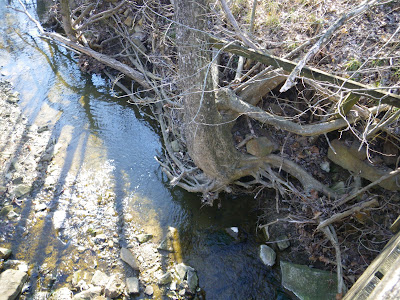
Typical Illinois River tributary southwest of Fayetteville, Arkansas, has siltation caused by Highway Department's dredging of roadside ditches
Please click on individual images to ENLARGE view of stream that enters the Illinois River. This one is near a highway and shows signs of dumping of assorted material in the creek. Worse, however, is that Arkansas Highway and Transportation workers mow and then dredge out ditches from which water from the highway carries silt into the stream. That reduces the success of many native species that inhabit the stream. It is easy to haul out the junk and debris. But silt is difficult to remove. Neither should be in the stream. Thoughtless people dump the junk into creeks. Well-paid workers dredge the ditches and cause the erosion at taxpayer expense!




Thursday, February 25, 2010
Hidden cost of hydraulic fracturing featured on CAT channel, Cox Cable 18 in Fayetteville, Arkansas
The morning of February 23, 2010, on Democracy Now (every weekday morning 7am CAT Ch. 18) Amy interviewed Josh Fox, the director of the new film, "Gasland."
He traveled about 10 states and discovered widespread pollution of groundwater by hydraulic fracturing. The or a connection to CCTF is the harm caused by the reckless search for additional fossil fuels. There are hidden costs in fracturing; the public needs to know the true costs in this and all energy sources. Also the corruption involved (another cost):
The 2005 Energy Bill exempted the natural-gas industry from the Safe Drinking Water Act especially to give free rein to fracking. Imagine the amount of money spent on campaign contributions and lobbying to produce that special corporate-interest legislature.
--
Dick Bennett
jbennet@uark.edu
Tuesday, February 23, 2010
Big white heron, mallard ducks flock together on the Illinois River when ponds in watershed were frozen
Please click on image to ENLARGE view of Illinois River waterfowl on January 6, 2010.


Tuesday, February 9, 2010
Photo montage of World Peace Wetland Prairie
Please click on image to ENLARGE and navigate up and down, right and left, to see whole montage.
 Montage by Lauren D. Hawkins with photos by Aubrey James Shepherd

Saturday, February 6, 2010
OMNI Center for Peace, Justice and Ecology invites all to open house from 3 to 6 p.m. today
View Larger Map
OMNI Center for Peace Justice and Ecology opens new house to all TODAY!
Office Phone: (479)935-4422
omni.center.for.pje@gmail.com
“OMNI Center for Peace, Justice & Ecology
educates and empowers people to actively
build a non-violent, sustainable and just world.”
Saturday,
February 2010
3:00—6:00 PM
3274 N. Lee Ave
OMNI CENTER for PEACE, JUSTICE & ECOLOGY
You are invited to celebrate the dedication of
OMNI Center’s new building! Enjoy music, re-
freshments, good fellowship, speakers, and
tours! Learn more than 35 ways to be involved
in OMNI. Help build a culture of peace in an
earth restored, that includes everyone.
Children
Welcome!
Handicap
Access
Refreshments
Will Be
Served!
Open House!
Subscribe to:
Posts (Atom)
